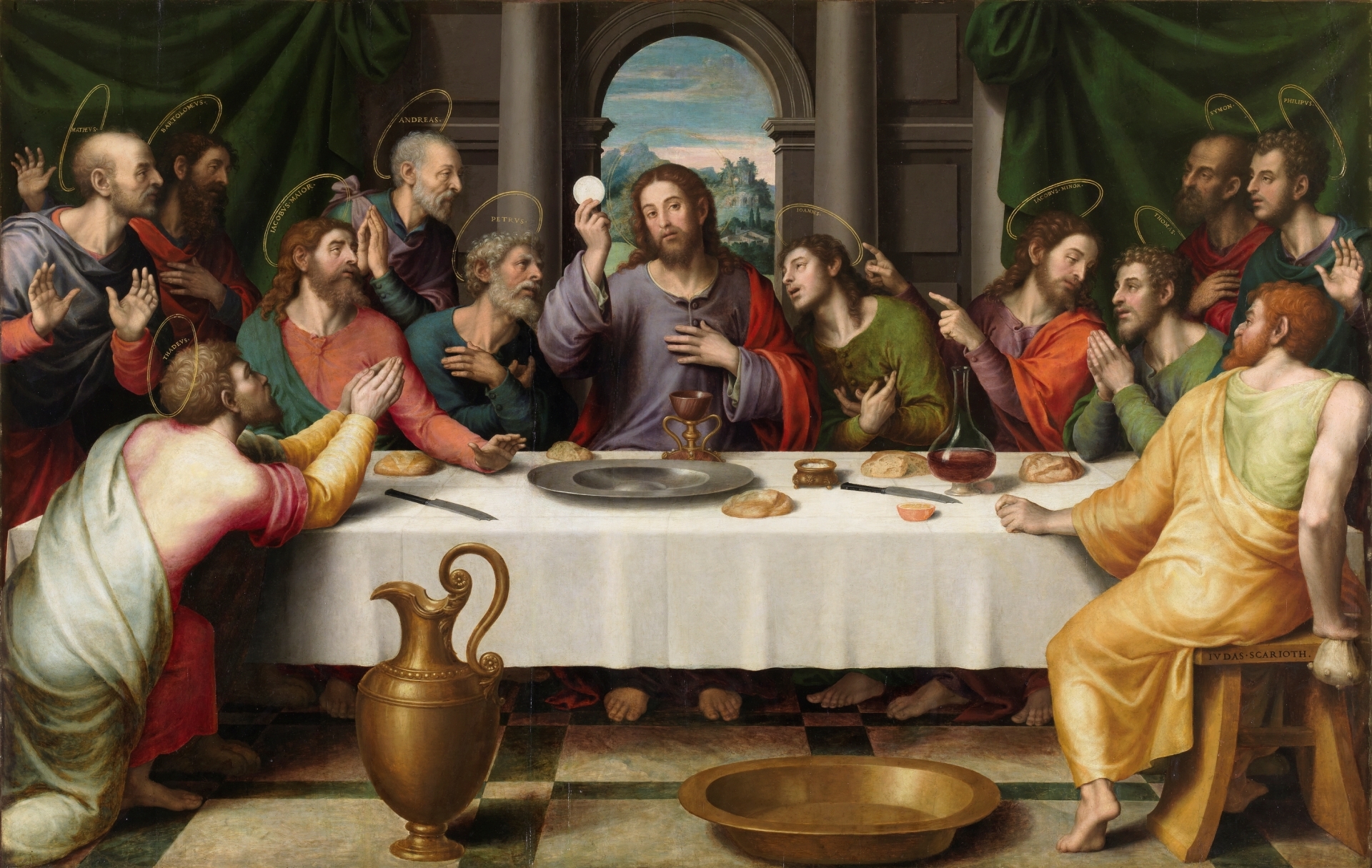
The Easter Triduum begins with the Mass of the Lord’s Supper, where the Church commemorates the institution of the Eucharist, the greatest gift Christ entrusted to His people. One of the most striking visual meditations on this mystery is The Last Supper by the Spanish Renaissance painter Juan de Juanes (1560s). His masterpiece draws us directly into the sacred drama of Holy Thursday and invites us to rediscover the meaning of the Mass.
A Painting That Mirrors the Liturgy
Juanes does more than depict the historical event of the Last Supper. He paints the liturgy itself, allowing the viewer to step into the mystery rather than simply observe it from a distance. The scene is carefully arranged to echo what takes place at every altar.
In the foreground, the amphora and basin quietly evoke the washing of the feet, a sign of Christ’s humility and self-giving love. The table, covered in a pure white cloth, resembles an altar, and the apostles are arranged in a semi-circle, to represent the faithful gathered around the altar of the Lord.
One figure, however, stands apart. Judas Iscariot alone is without a halo. His name is inscribed in dark lettering, a stark reminder that betrayal has already taken root in his heart (cf. John 13:27). Even in this moment of grace, the possibility of rejection remains, a quiet warning that the gift of Christ’s presence must be freely received.
The Moment of Consecration
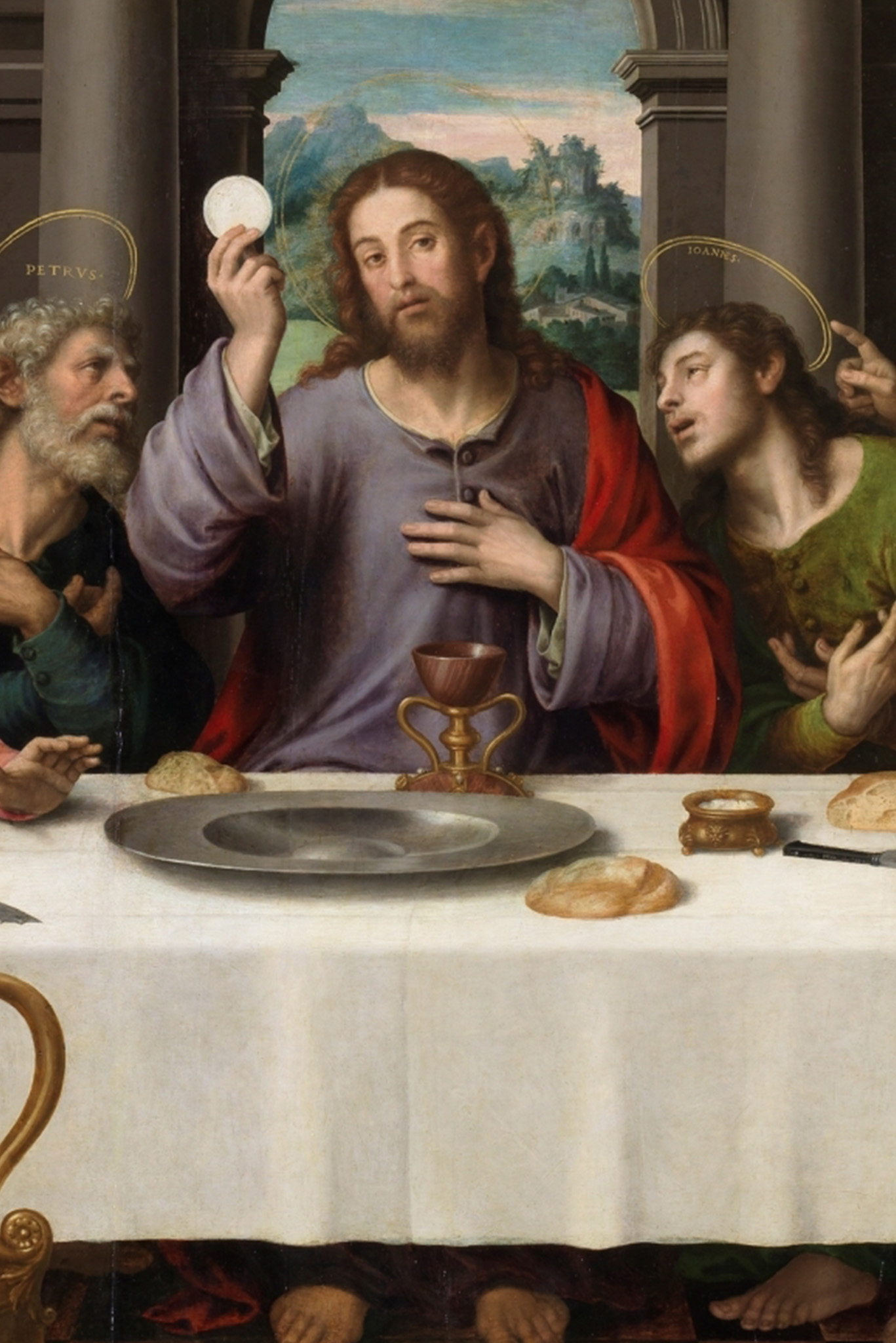
We are then drawn into the most sacred instant, the institution of the Eucharist. Christ raises the Host, echoing the words still spoken at every Mass: “This is my Body, given up for you” (Luke 22:19). His gesture is deliberate and solemn. One hand lifts the consecrated Host, while the other rests upon His chest, emphasizing the profound truth that this is not a symbol, but His very Body.
The apostles respond in a striking way. They do not look at the face of Christ, but instead gaze in adoration at the Host. Their posture anticipates the faith of the Church through the centuries. Christ is truly present in the Eucharist, and He draws the eyes and hearts of His disciples to Himself under the appearance of Bread.
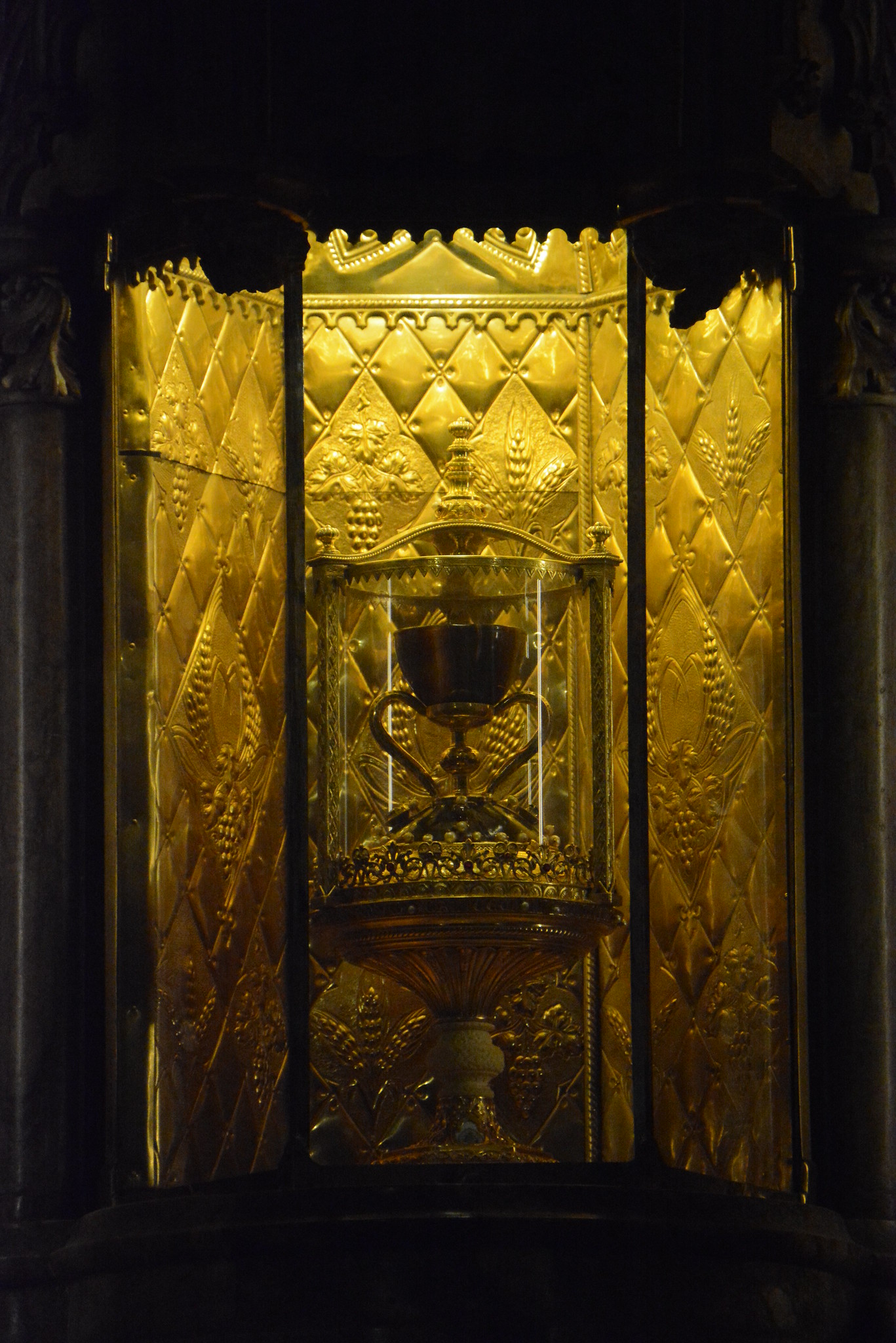
Holy Grail Valencia Foto: Simon Flickr https://www.flickr.com/photos/walhalla/
The Chalice and the Sacrifice
The chalice rests prominently on the table, containing the Precious Blood soon to be shed for the forgiveness of sins. It points forward to Good Friday, revealing that the Last Supper and Calvary are one single sacrifice made present in different ways.
Juanes includes a remarkable historical detail in the design of the chalice, which resembles the one preserved in Valencia Cathedral and traditionally believed to be the cup used by Christ Himself. Whether understood historically or symbolically, its presence reinforces a powerful truth. This event is not myth or metaphor, but reality, grounded in history and extended through time.
That reality continues in every Mass. What Christ instituted on this night is not a distant memory, but a living mystery. The sacrifice is not repeated, but made present again, as the command of Christ still resounds: “Do this in memory of me” (Luke 22:19).
A Question for Our Hearts
Holy Thursday is not only about remembering. It is about responding. Like the apostles, we are invited to fix our gaze on the Eucharistic Lord and to recognize Him truly present.
When we attend Mass, we stand within and participate in the same mystery that Juanes has painted. Christ gives Himself completely, Body and Blood, Soul and Divinity, so that we might be united with Him and transformed by His presence.
The question that remains is simple, yet searching. Do we adore Him as He deserves?
On this Holy Thursday, may we rediscover the wonder of the Eucharist. And like the apostles, may we learn to recognize, love, and receive the Lord who gives Himself entirely for us.