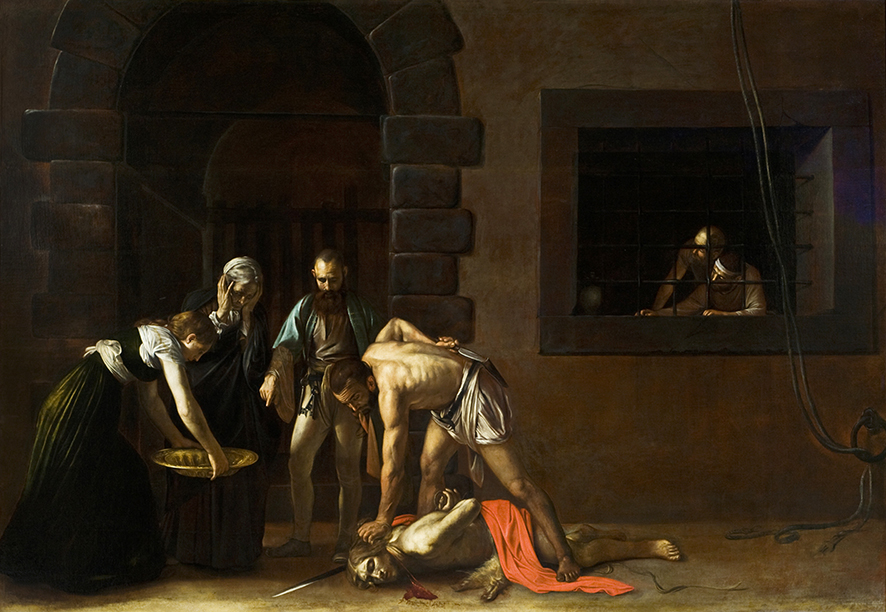
Many artists have depicted the beheading of the Baptist in the grim prison of Herod's palace (cf. Mk 6:14-29). Among them was Michelangelo Merisi, known as Caravaggio, who in 1608 painted his largest canvas (361 × 520 cm), The Beheading of Saint John the Baptist. Housed in St John's Co-Cathedral in Valletta, Malta, it is the only work the artist ever signed.
At the time, Caravaggio was a fugitive: for two years a death sentence for murder had hung over him in the Papal States. Having first taken refuge in Naples, on 14 July 1607 he reached Malta, governed by the Order of the Knights of Saint John. The work was commissioned by the powerful Grand Master, the Frenchman Alof de Wignacourt.
Caravaggio draws the viewer into the darkness of the prison. Beneath a broad stone arch a scene of death and violence unfolds. At the centre, the executioner looms over the lifeless body of the Baptist, struck down by a blow of the sword. With his left hand he grips him by the hair, while with his right he draws from behind his shoulder the dagger meant for the final blow. This short weapon, known as a "misericord," served precisely to end the agony of the condemned.
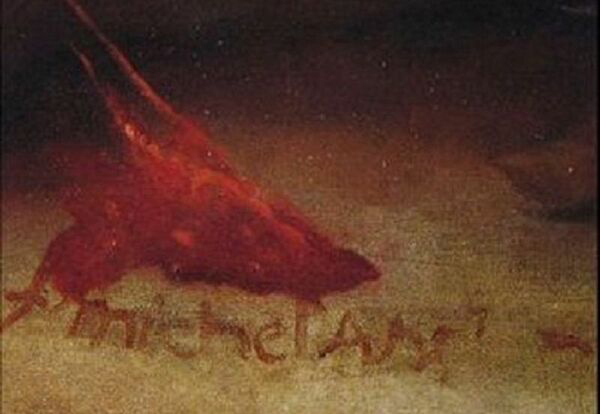
From the deep wound in the Baptist's neck, blood spreads across the floor. Within the red stain the signature "f. Michelang[e]lo" takes shape, in which the "f" stands for "fra" and alludes to his standing as a Knight of Magistral Obedience, a title reserved for members of non-aristocratic origin.
Beside the executioner, an impassive jailer orders a young servant girl to bring forward the basin destined to receive the head. Between the two, an old woman appears, raising her hands to her face in a silent cry of horror. On the right, behind a barred window, two men can just be made out watching the scene, probably fellow prisoners.
A soft yet intense light, not coming from any natural source, envelops the drama and brings out the vigour of the bare bodies of the executioner and the saint. The Baptist lies face down, his hands bound behind his back. A vermilion red cloak wraps around him, letting the characteristic camel skin show through.
On the right, the supernatural light reveals a rope and an iron ring fixed in the wall, signs of what has just taken place: the prisoner has been untied to be executed. The executioner's sword failed to sever his head with the first stroke and left him in agony; for this reason the man, before the eyes of those present, takes up the dagger and prepares to complete the execution.
The light guides the narrative and illuminates the martyr's last breath. The blood he sheds seals the fulfilment of his mission: to prepare the way for Christ, "the Lamb of God, who takes away the sin of the world" (Jn 1:29).
Caravaggio identifies deeply with the Baptist: he too lives under a sentence of death. The painter hopes the Pope may commute it in an act of clemency and, above all, trusts in God's mercy for his own eternal salvation.
The painting was intended for the choir of the oratory, built over the cemetery where the Knights were buried, including those martyred by the Turks. Here the monk-knights would gather to pray and to make important decisions. The martyrdom reminded them that their arduous mission to free the Holy Land and to rescue the Christians enslaved by the Turks could demand, at any moment, the sacrifice of their lives for Christ.