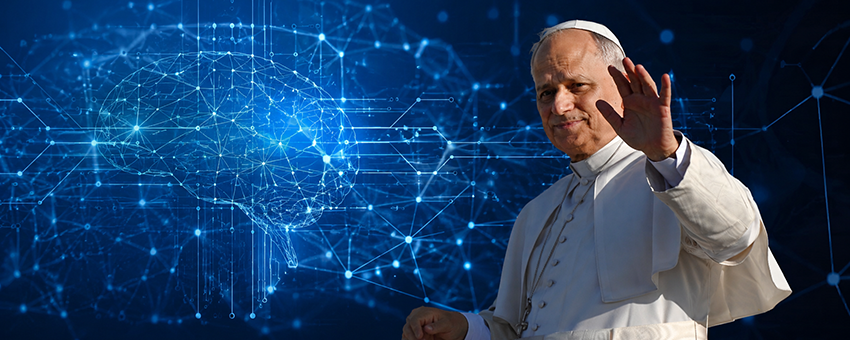
With the encyclical “Magnifica Humanitas: On Safeguarding the Human Person in the Time of Artificial Intelligence”, Pope Leo XIV offers the Church and the entire world a profound act of discernment. It is neither a condemnation of technology nor a naive enthusiasm, but rather an invitation to look deeply, with the eyes of faith, at the epochal transformation we are currently experiencing.
The encyclical opens with a powerful image of Babel and Jerusalem: “Humanity, created by God in all its grandeur, is today facing a pivotal choice: either to construct a new Tower of Babel or to build the city in which God and humanity dwell together.” (MH, no 1) It is not a matter of choosing between accepting or rejecting technology, but of something more radical: choosing between a use that fragments, and one that safeguards the human. In a time when, as the Pope writes, “never has humanity had such power over itself,” (MH, no 4) his responsibility becomes urgent and inescapable.
At the heart of the document lies a certainty that the Christian faith has cherished since the very beginning: the human being cannot be reduced to a function, a datum, or a performance. There exists "the more profound and important level of ontological dignity,” a dignity “that belongs to every human being simply by virtue of existing, of having been willed, created and loved by God.” (MH, no. 52) This dignity does not depend on what one produces or on how "useful" one is. It precedes everything, for it comes from God: “The truth is that only in the mystery of the incarnate Word does the mystery of man take on light.” (MH, Introduction no. 1) The Incarnation is not merely a theological dogma; it is the criterion by which to interpret history, including digital history.
The encyclical is lucid on a point we often overlook amidst the allure of technological novelty: artificial intelligences, however sophisticated, remain alien to the human experience. Further, they “do not undergo experiences, do not possess a body, do not feel joy or pain, do not mature through relationships and do not know from within what love, work, friendship or responsibility mean.” (MH, no. 99) For this reason, they cannot assume moral responsibility. Limitation is not a defect to be eliminated; rather, "humanity flourishes not despite limitations, but often through them.” (MH, no. 118) It is within fragility and vulnerability that relationships, care, and openness to the other are born - all things that no machine can ever generate.
Descending into the concrete reality of daily life, the Pope identifies three spheres in which the safeguarding of the human is at stake: truth, work, and freedom. Truth is a fragile common good, threatened by the proliferation of manipulated information: "The quality of public communication depends directly on social trust and, in turn, shapes it,” (MH, no. 132) and technical filters alone are not sufficient. Work, “a requirement of the human condition”, (MH, no.149) risks losing its human value when workers need “to adapt to the speed and demands of machines, rather than machines being designed to support those who work.” (MH, no. 150) Finally, freedom in the digital age "is not merely a matter of interiority but also a public concern,” for technologies possess the power to invisibly steer choices and behaviours. (MH, no. 171)
The encyclical concludes with a horizon of hope: a "civilization of love" (MH, no. 219) serving as a concrete alternative to a "culture of power", (MH, no. 221) one founded upon justice, fraternity, and dialogue. The canticle that inspires this vision is Mary’s Magnificat, the very source of the encyclical’s title, standing as a sign of a logic that overturns power and affirms the value of humility. The Pope’s final invitation is clear: to be "builders of communion, not architects of Babel," so that humanity may not lose its inherent magnificence, and the world may recognize, within the human heart, the very place where God desires to dwell.
To read the full text of the encyclical and access supplementary materials, visit: humandevelopment.va